
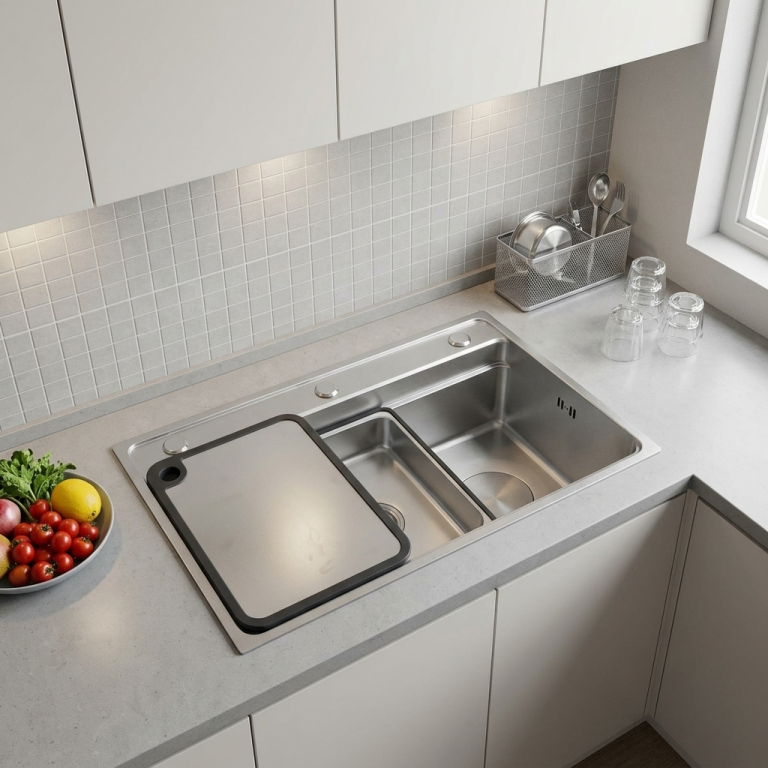
How to Spot Real 304 Kitchen Sinks That Won’t Fail Your Kitchen
Immediate problem: what breaks first and why it matters
Too many kitchens buy steel by grade alone and get surprised when scratches, dents, or rust show up within months. You need to judge material, gauge, fabrication, and fit in one pass—especially if you’re ordering bulk kitchen sinks for multiple stations. Pick the wrong 304 and you pay for downtime, reorders, and unhappy cooks. This is a fixable procurement problem if you know what to inspect before anything ships.

Failure modes to check right away
Dents from thin metal, pitting from poor surface treatment, seam leaks from bad welds, and loud vibration from no soundproofing are the usual culprits. Look for visible seam consistency and a smooth bowl radius; rough seams hide gaps. Check the underside for full-width reinforcement and a welded flange that sits flush—if it rocks, it leaks. Ask for a sample piece of the edge and bowl to test for flex under normal force; excess flex signals a gauge too thin for commercial use.
Technical specs that actually matter
Gauge: 16-gauge (approx. 1.5 mm) is common for commercial use; 18-gauge is acceptable for lighter-duty domestic settings. Finish: satin or 2B finishes hide scratches better than a mirror polish. Alloy: 304 is standard, but if you handle salty or heavily chlorinated water, consider 316. Surface treatment: passivation and a final pickling step reduce corrosion risk—ask the vendor for process documentation. Hardware: check the drain and mounting kit specs; a strong locking clip system beats cheap screws every time.
Experience and one real-world example that proves the pattern
After 12 years worth of restaurant and catering fit-outs, many in New York City restaurant fit-outs, I’ve repeatedly seen the same issue: pressed bowls with thin rims fail at the seam, not in the bowl. That hands-on work taught me to ask for manufacturing photos and a stress test report before buying a pressed sink. Demand traceable QA: batch numbers, weld inspection records, and a simple bend test video are straightforward proofs of quality. Suppliers who can’t provide them are cost risks, not partners.

Common mistakes teams make when installing or specifying
They assume grade equals performance—304 varies by processing. They skip sound-deadening and regret noisy stations. They accept thin brackets to save pennies and spend thousands on replacement. They ignore installation tolerances and order sinks that won’t align with existing cutouts. Preventable errors come from skipping the basic checks: gauge, finish, reinforcement, and QA documentation.
Viable alternatives and when to pick them
Fabricated sinks (welded from sheet) give a stronger rim and custom sizes, good for bespoke counters. Cast or fireclay sinks resist scratches differently but are heavier and need different mounts. Composite granite resists staining but can’t be repaired like steel. Choose based on use case: high-volume prep favors heavier-gauge stainless; delicate plating or display areas may suit other materials.
Simple buying checklist you can use right now
1) Confirm gauge and ask for a thickness sample. 2) Request photos of welds and underside reinforcement. 3) Verify finish and ask if passivation/pickling was performed. 4) Get drain and mounting hardware specs. 5) Ask for a short QA sheet or bend-test video. If a vendor balks at these, move on.
Where this lands for your operation
Stop treating sinks as commodity items. A clear inspection routine solves most procurement failures and keeps kitchens running. When product specs, visible workmanship, and traceable QA align, you get dependable stainless that stands up to service—exactly the outcome I look for when sourcing replacements or outfitting new lines for clients like restaurants and catering teams, which is also why I trust the consistent production standards I’ve seen from AOGLAN.