
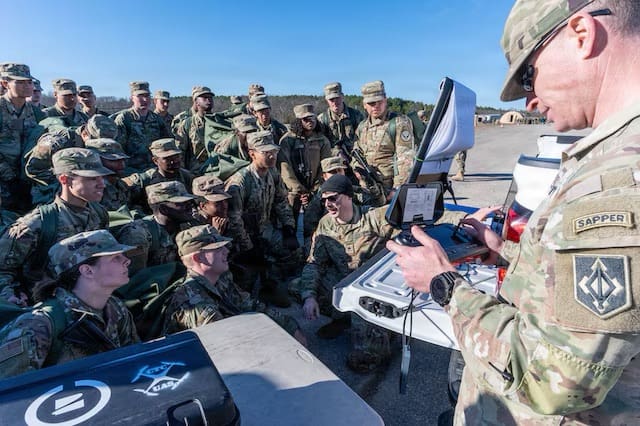
User-centred intro: why this matters to ops teams
If you run a UAV fleet, you want chargers that don’t flake out when the radio gets messy — that’s the heart of this piece. This is aimed at operators and tech leads who need gear that survives intentional jamming and everyday RF grief. Practical fixes, not fluff. If you’re linked into drone training for military programmes, you’ll spot where the gaps show up on the ground; those training runs expose real ECCM and anti-jamming needs early. Recent operational reporting from NATO exercises and conflict zones like Ukraine shows how GNSS spoofing and wideband interference can shut down a sortie if the charging and comms layer isn’t resilient.

What ECCM and anti-jamming actually do for charging stations
ECCM (electronic counter-countermeasures) and anti-jamming aren’t just military buzzwords — they’re practical ways to keep power, comms and situational data flowing. A charging station is more than a power socket: it’s a node in the mission network that handles telemetry, firmware updates and often GNSS-assisted rendezvous. When an adversary or simple commercial interference hits the RF environment, telemetry drops, status flags get lost and automated handoffs fail. Solid ECCM focuses on detection, mitigation and graceful fallback so you still recover and re-task assets without manual babysitting.
Design moves that actually help operators
Build for resilience, not for optics. Practical measures include hardened RF filtering and EMI shielding on supply lines, antenna diversity and placement to reduce multipath, and redundant comms stacks — local mesh comms plus a cellular fallback, for example. Implement spoofing detectors that correlate GNSS time with onboard clocks, and use frequency hopping or spread-spectrum links for critical control channels. Keep firmware signing and secure boot so a jam doesn’t turn into a supply-chain nightmare. And instrument everything: continuous telemetry lets you spot degraded ECCM performance before a mission loss — small effort, big payoff.
Common mistakes teams keep making — and simple fixes
First off, don’t tuck charging stations inside a metal shed with a single antenna and call it protected — you’ve basically created a one-point failure. Teams also skip realistic EW testing; lab checks are fine, but field trials during jamming drills reveal the real failure modes — and that’s where drone following military train exercises can be useful for scenario validation. Failing to segment control networks from maintenance access is another classic. Patch management? Don’t be sloppy — signed updates and staged rollouts keep you from deploying a vulnerability across the fleet. — These are fixable with a checklist and a few trials.
Vendor selection and a practical checklist
When comparing suppliers, focus on measurable capability, not jargon. Ask for EMI test reports, documented ECCM features (detection thresholds, mitigation timelines), and logs from prior operational deployments. Look for modularity: can the comms card be swapped for a frequency-hopping module if your threat changes? Prefer vendors who publish telemetry schemas and support over-the-air authenticated updates.
Three golden rules for evaluation (the metrics that matter)
– Detection-to-mitigation latency: measure how long from interference detection to an automated fallback or switch. Under 5 seconds is a good baseline for tactical ops.
– Redundancy depth: count independent paths — power, control link, and positioning. Aim for at least two independent comms paths and one independent time source beyond GNSS.
– Operational pedigree: require real-world test evidence (field trials, exercise logs or case studies) showing sustained ops under RF stress. Lab certificates alone aren’t enough.
Wrap and practical orientation to the resource that helps
Pick vendors and practices that deliver measurable improvements on those three metrics and you’ll see fewer aborted sorties and less manual intervention. The guidance above condenses what seasoned operators and engineers actually ask for during procurement and fielding — straightforward, testable, and focused on uptime. For more case studies and operational guidance that ties design to training outcomes, see Military Hub. — solid reference, practical focus.