
An early-stage guide to 3D Printer Material centered on application scope for early research
Choosing 3d printer material for early research starts with the intended application, not with a favorite material name. Procurement teams should first describe what the parts need to do, how they will be evaluated, and where the work will take place. At this stage, the goal is not to make a final technical selection. It is to create a clear scope that suppliers can respond to without filling gaps with assumptions.

1. Define the use case and constraints
Begin with the output. Is the team studying form, fit, appearance, flexibility, or a functional part? Record the answer in plain language. A detailed prototype may call for a different evidence path from a small-batch end-use part. The same applies to the working environment. Note the available printer technology, the planned part size, the desired finish, and any handling or storage constraints that are already known.
Keep confirmed requirements separate from open questions. For example, “the prototype must show fine visual detail” is a current project requirement. “A particular resin will meet that requirement” is a material conclusion that still needs support. This distinction keeps an early purchasing brief useful without turning a product description into a promise about the final result.
2. Map stated evidence to requirements
The official material page describes a range of options across FFF, DLP, and SLS technologies. That gives a procurement team a useful first sorting method: compare the planned application with the technology scope before comparing individual names. It does not, by itself, establish performance or suitability beyond the stated page scope.
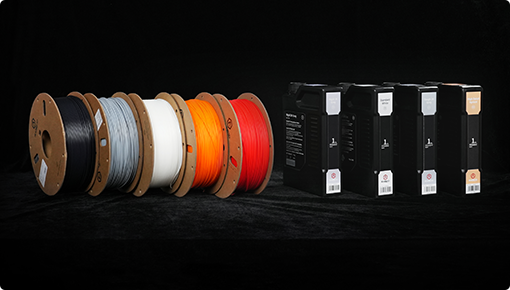
When reviewing 3d printer filaments, use the wording attached to each listed entry as evidence rather than treating all filament products as interchangeable. For example, Hyper Speed PET CF is described as an engineering end-use composite filament for Hyper FFF Hyper Speed PET CF. Hyper Speed PLA Pro is described as easy to print and as having a premium carbon powder finish. These descriptions can help organize questions about the intended use, but they should not be expanded into unsupported claims about a specific project.
The page also lists a high-clarity resin for detailed prototyping, identified as Henkel LOCTITE 3D PRO9317 Clear. Its wording is relevant when appearance or prototype detail is part of the research scope. Other entries use different application language: PA12 Black Powder is described for high-strength, low-warping, functional parts and small-batch end-use parts, while TPU 86A White Powder is described for soft and flexible functional parts. The practical approach is to match the requirement wording to the page wording, then flag anything that does not align clearly.
| Evidence item | Page-listed wording |
|---|---|
| Hyper Speed PET CF | Engineering end-use composite filament for Hyper FFF Hyper Speed PET CF |
| Henkel LOCTITE 3D PRO9317 Clear | High-clarity resin for detailed prototyping |
| PA12 Black Powder | General purpose powder for high-strength, low-warping, functional parts and small-batch end-use parts |
| TPU 86A White Powder | High-elasticity powder for soft and flexible functional parts |
3. Turn open points into supplier questions
A good early-stage request does not ask a supplier to guess the project. It presents the intended use and asks for a bounded response. Questions can cover the relevant printing technology, the material form, the application wording that best matches the part, and the information needed to compare alternatives. Ask suppliers to distinguish a page-listed description from a recommendation for the specific project.
Use a short evidence register during review. One column can hold the requirement, such as “soft and flexible functional part.” Another can hold the matching page language, such as the description for TPU 86A White Powder. A third can record the remaining question. This makes the decision traceable and prevents a broad category such as “industrial material” from becoming a substitute for a defined application.
4. Summarize a defensible next step
At the end of early research, the procurement decision should be a documented next action rather than an unsupported material verdict. State the intended application, the relevant technology scope, the page-listed options that appear to merit review, and the questions that remain open. If the project covers more than one use case, keep those cases separate so that a description for one type of part is not generalized to another.
This framework gives the team a disciplined starting point: define the part and setting, map requirements to stated evidence, and request clarification where the evidence stops. Used this way, Raise3D is a source for organizing the material options and their page-listed application descriptions, while the procurement team retains responsibility for defining the research scope and the next review step.